

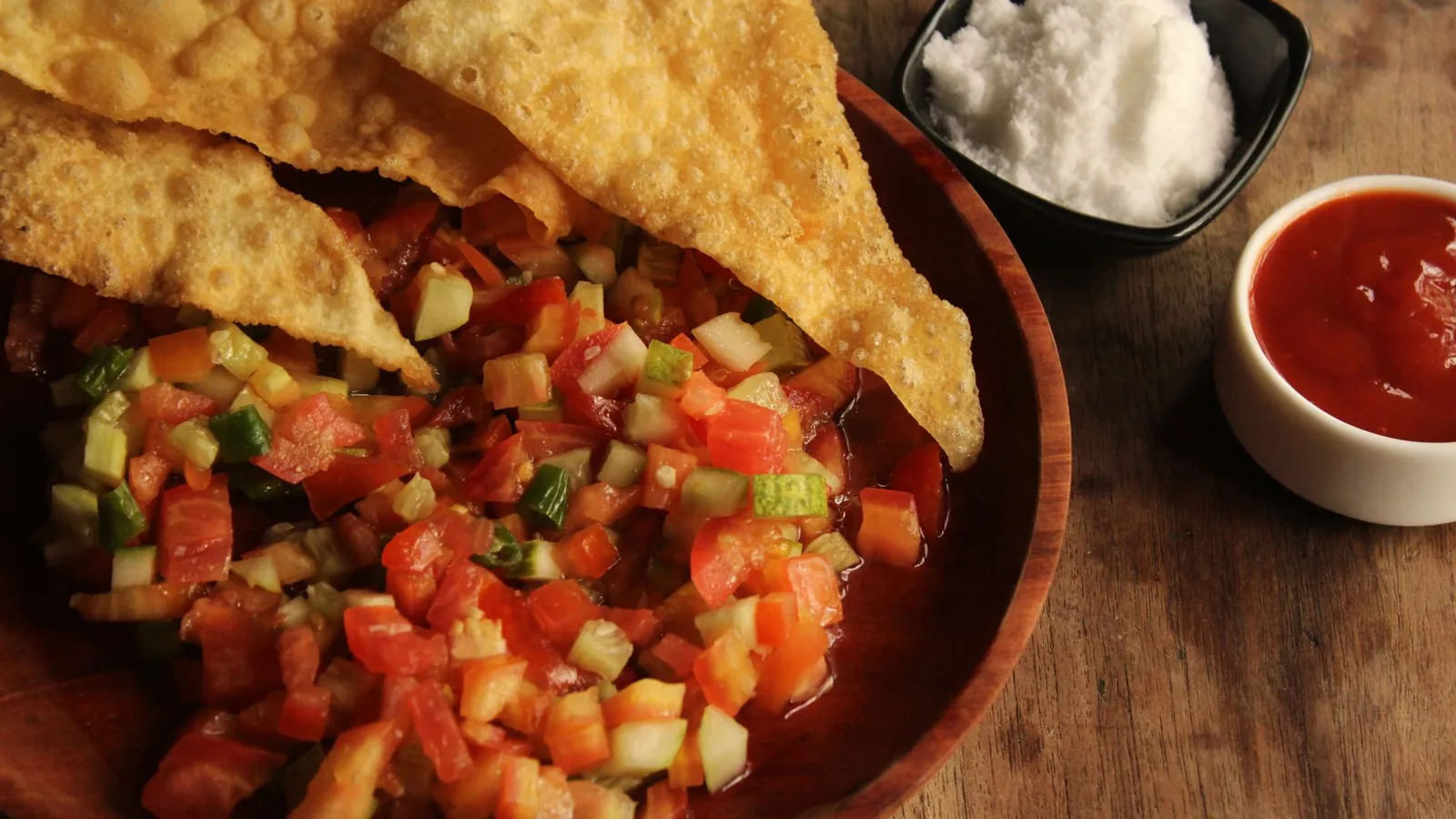
Imagine a production lead taking a spoonful of sauce from the kettle. The vegetable pieces look generous and distinct. At the filler, the same sauce arrives dotted with tiny fragments. Somewhere along the transfer route, the chunky recipe has become a much finer interpretation of itself.
The cooking record may be perfectly familiar. This time, the investigation follows mechanical handling: how the sauce moves through equipment, where pieces meet restrictions and how often they travel around the circuit. The recipe has to survive the journey as well as taste right at its starting point.
A piece meets more than moving liquid
Inside a transfer system, vegetable pieces can be squeezed, struck, dragged or cut between moving and fixed surfaces. The surrounding sauce also subjects them to changing forces as flow accelerates, slows or changes direction. Soft pieces may break where firmer ones pass intact.
Piece size matters relative to the route available. A component described as suitable for a certain particle size does not automatically guarantee gentle handling of every vegetable with that dimension. Shape, flexibility and cooked firmness affect how a piece passes through an opening.
A long strip can behave differently from a compact cube. A tender outer layer can rub away even if the centre survives. Look at the fragments as well as the remaining pieces: torn edges, flattened sections and fine debris can suggest different kinds of mechanical damage.
Draw the real route
Begin at the kettle outlet and follow the sauce to the deposited portion. Include the pump, pipework, bends, valves, connecting fittings, holding vessels and filling nozzle. Restrictions outside the pump can damage particles even when the pump itself is suitable.
Ask what happens during a pause. Does the product recirculate? Does it return to the kettle or pass repeatedly through a small loop? A gentle-looking single pass can become a rough journey when repeated. Record the route actually used during running, waiting and restart.
Changes in valve position or line arrangement can create local differences in flow. Check the operating setup against the intended configuration. Do not assume that a line assembled from familiar parts offers the same clearances and handling conditions every time.
The vegetable brings its own strength
Check the pieces before they enter the transfer system. Cooking, raw-material maturity and earlier handling affect their ability to resist damage. A pump may reveal weakness already present in the vegetable rather than create the entire problem on its own.
Compare incoming piece dimensions and cooked firmness across trials. If one batch has softer vegetables, its breakage cannot be fairly attributed only to a pump setting. Keep the preparation and sampling conditions aligned while investigating the equipment.
Product temperature and sauce consistency matter as well. They influence how the mixture moves and the conditions under which the equipment operates. Record them at relevant points, especially if the sauce thickens or cools during a delay. A warm kettle sample and a cooler filler sample have had different journeys.
Find the first point of damage
Take representative samples before and after accessible transfer stages using approved sampling points. Begin with the kettle, then narrow the route around the first clear change. Safe, hygienic access is essential; opening a pressurised line is not a sampling method.
Use gentle, consistent sample handling. Forcing a sample through a narrow utensil or stirring it vigorously can introduce the very damage being investigated. If pieces need separating from the sauce for inspection, use a documented approach that does not break them or wash away the evidence unevenly.
Compare samples at matched temperatures and with the same assessment method. Look at the distribution of sizes, the condition of edges and the amount of fine material. A photograph of a selected intact cube tells much less than a representative spread of the whole sample.
A route-checking checklist
- Record piece dimensions and firmness before transfer begins.
- Map pumps, restrictions, bends, valves and the filling nozzle.
- Include recirculation, pauses and restarts in the route history.
- Compare gentle samples before and after the suspected damage point.
- Assess proposed changes for capacity, hygiene and process control.
Discuss clearances, equipment suitability and operating conditions with the responsible engineering and production team. A change that preserves pieces but causes blockages, unstable filling or an uncleanable arrangement has not solved the production problem.
Reducing unnecessary passes or revising a restrictive route may be worth a controlled trial. Any change still needs to maintain the required product handling, heating or cooling conditions and cleaning arrangements. Review the complete process before adopting a promising local adjustment.
Finish by checking the packed product through its intended preparation. Intact pieces at the nozzle are encouraging, but the meal also needs consistent distribution between packs and an enjoyable bite after reheating. Keep those final checks connected to the transfer observations.
The kettle and filler can tell the same chunky story once the troublesome part of the route is understood. Ask Specsy or the SpecSol team to help organise your observations. Sometimes the recipe is ready for production, and it is the journey that needs a little more care.