

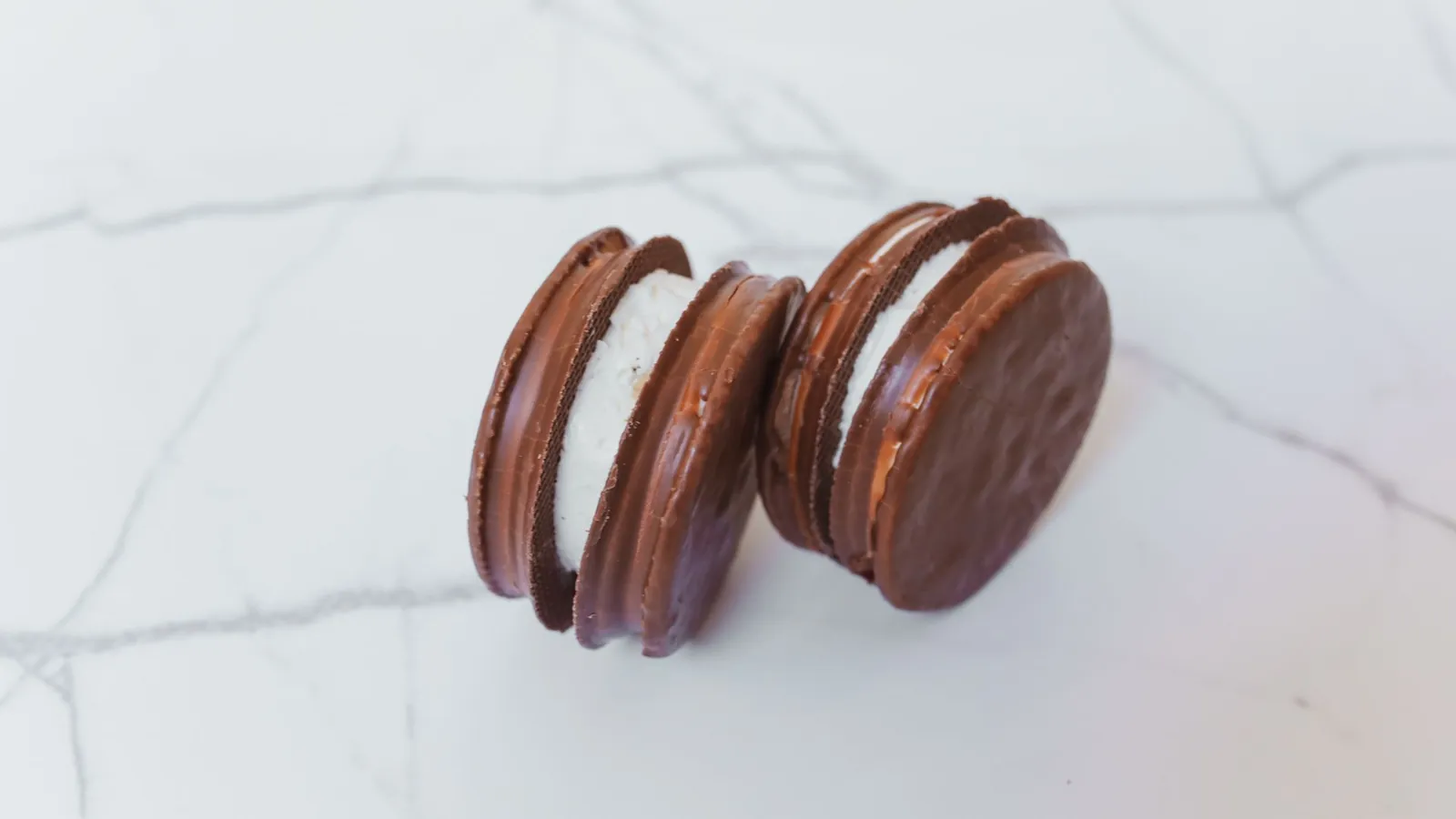
Picture a packing operator lifting a biscuit sandwich from the belt. The top is straight, the bottom looks good, but a pale ribbon of cream peeps beyond the rim. Further upstream, the freshly deposited filling looked perfectly tidy. Somewhere between the depositor and the wrapper, the cream has made a run for the edge.
The filling has a demanding job. It must spread enough to join the biscuits without breaking them, then resist further movement during handling. Those requirements happen close together. A recipe that looks convincing in a bowl still has to negotiate warm biscuits, pressing, stacking and the trip into its pack.
Easy to spread, ready to stay
Many sandwich biscuit creams contain fine solid particles dispersed through a fat phase. Their firmness and flow depend on composition, particle properties and the structure of the fat. The relevant behaviour is how the complete filling responds under the actual assembly conditions.
Temperature is particularly important for a fat-based filling. As the balance of solid and liquid fat changes, the filling can become easier or harder to move. Its earlier cooling and working history can influence that structure too. A temperature reading is useful, but it should travel with a preparation record.
The filling needs enough movement during sandwiching to create the intended contact. Afterwards, excessive movement can expose cream at the edge or let the biscuits slide. Very firm cream is not automatically better: it may spread poorly, give uneven adhesion or require enough pressing to damage a fragile biscuit.
The biscuit brings its own temperature
Measure the biscuits as well as the cream. Biscuits arriving warm from cooling can transfer heat to the filling after deposition. A cream judged at the depositor may therefore soften during the very stage when the team expects it to hold its shape.
Compare temperatures across the line and during changes in production pace. A shorter cooling interval or a temporary queue can alter the conditions reaching assembly. Keep those observations attached to the samples rather than calling all biscuits from the same bake equivalent.
Look at flatness and surface shape too. A curved biscuit or raised area can concentrate pressure locally. The filling may find an easy route towards one edge while the rest barely spreads. A sideways smear can be a geometry clue, not simply evidence that the cream is too soft.
Follow the deposit through the press
Deposit placement sets the starting point. An off-centre mound has less distance to travel before reaching one rim. Check centring, portion consistency and the condition of the depositing nozzle. Observe several successive sandwiches to see whether the fault is steady or appears only occasionally.
Then inspect the sandwiching action. Pressure, alignment and contact time all affect spreading. Changes should be considered together with biscuit strength and line setup. More force can improve contact in one situation and turn an otherwise suitable filling into an exposed ring in another.
Watch the next stages as carefully as the press. A sandwich that looks neat immediately after assembly may meet additional compression when stacked or wrapped. Compare the product before and after each stage so that the first point of failure becomes visible.
Give the sandwich its whole audition
Agree on the intended appearance and eating experience before testing. Include the acceptable position of the filling, biscuit alignment and the way the sandwich breaks during a bite. A visually tidy sample can still feel waxy, greasy or unusually hard.
- Record filling preparation, temperature and holding history.
- Measure biscuit temperature and inspect flatness at assembly.
- Check deposit position and portion consistency.
- Observe spreading during sandwiching and any biscuit damage.
- Compare samples before stacking, after wrapping and after holding.
- Taste for cream texture and the balance between filling and biscuit.
Keep the interval between assembly and later handling consistent during a comparison. A filling whose fat structure develops during cooling may respond differently after a rest. Record that interval rather than assuming that every sandwich gets the same opportunity to become firm.
Correct the cause before tightening the recipe
If the problem begins with off-centre deposition, improve placement before changing firmness. If it follows warm biscuits, investigate cooling and scheduling. If only the wrapper produces the exposed rim, review its handling conditions with the production team while maintaining proper pack formation.
Change one relevant variable at a time and retain a reference. When formulation trials are needed, compare them through the same complete line sequence. Judge the packed product after the intended hold as well as immediately after production, because the final eating texture is part of the brief.
Keep records of both squeeze-out and broken biscuits. A change that hides the cream by pressing less may leave poor contact; a firmer filling may protect the rim while increasing breakage. The useful answer balances assembly, handling and a pleasant bite.
The cream does not need a stronger border. It needs the right conditions to spread once and then settle into its job. Ask Specsy or the SpecSol team to review your assembly observations, and give the next biscuit sandwich a tidier journey to the pack.