

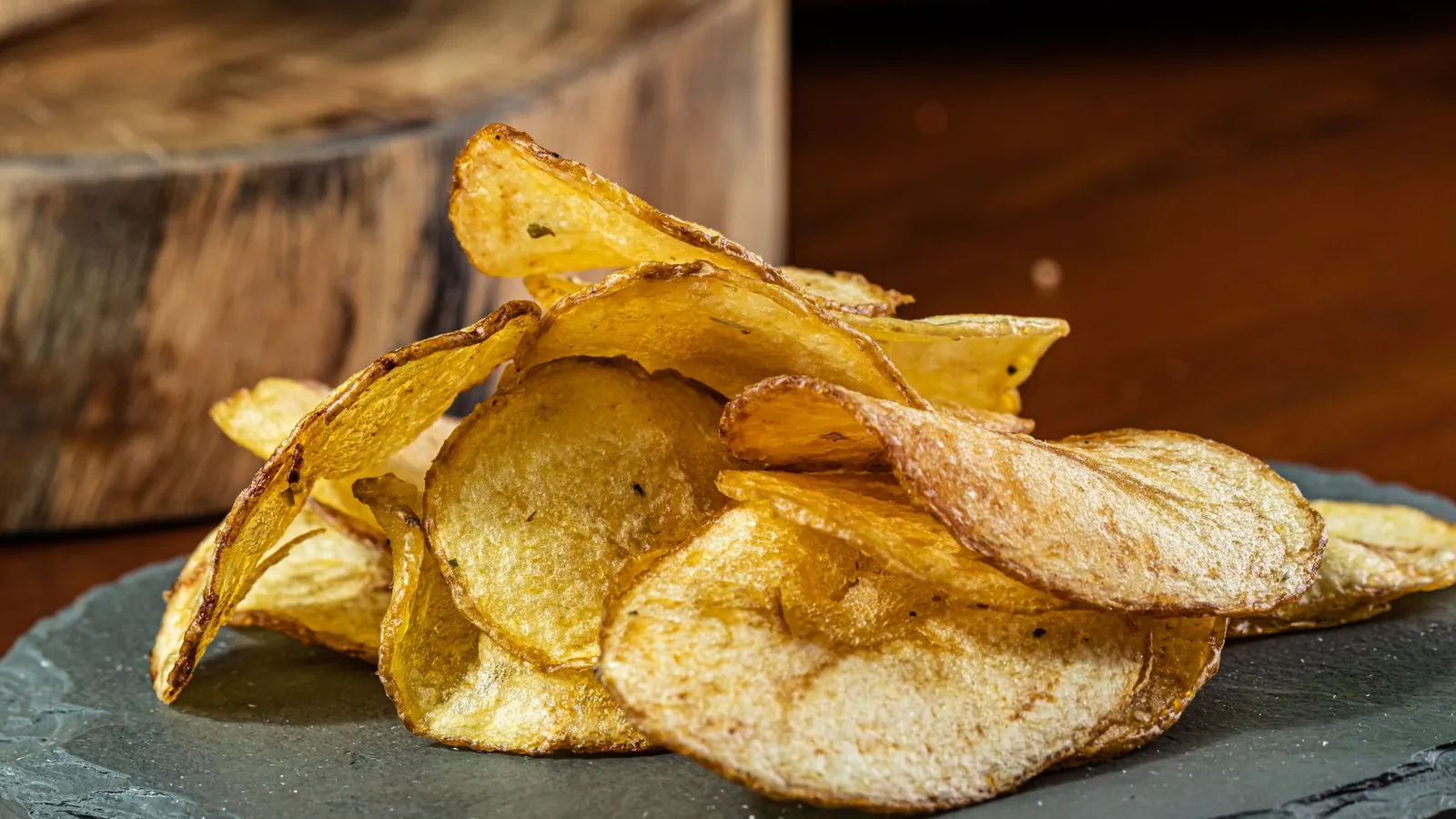
Picture a snack developer lifting freshly fried potato chips onto a draining tray. The handling looks careful, the colour looks promising and there is no obvious pool of oil. Yet the cooled chip leaves a heavier bite than expected. The tray seems innocent. The mouth is less convinced.
Oil in a finished chip is more than the shiny film you can see. Some remains on the surface, and some enters the structure created during frying. To understand the result, follow the chip through cooking, removal, draining and cooling.
Water leaves a changed structure behind
A raw potato slice contains water within a cellular structure. In the fryer, heat drives water evaporation while the food's starch and other components change. The slice becomes a very different material from the firm, moist piece that entered the oil.
Water loss helps create a porous structure. Those pores and the pathways between them matter because they provide places that oil can reach. Their size, connectivity and surrounding structure depend on the raw material and its processing history.
It is tempting to imagine each drop of departing water being replaced immediately by oil. The real process is less tidy. Water vapour, the evolving crust and oil movement interact, so moisture loss alone cannot tell you exactly how much oil the finished chip contains.
The cooling stage still has a role
After removal from the fryer, oil can remain on the chip's surface. As the chip cools, vapour inside can condense and internal pressure can fall. Together with capillary effects, this can draw available surface oil into accessible pores.
That makes the period after frying part of the oil uptake story. A chip has not finished changing simply because it has left the hot oil. How surface oil is removed, and what happens before and during cooling, can influence the final result.
This does not mean every frying system behaves identically or that all oil enters at the same stage. Treat the mechanism as a reason to inspect the full sequence. A universal promise about a draining trick would skip the differences between products and equipment.
Start with the slice
Check the potato lot and the condition of the prepared slices. Slice thickness, uniformity, damaged edges and surface moisture can affect how the pieces cook. An uneven feed can send quite different starting materials through the same nominal frying conditions.
Review any washing, rinsing or drying steps and record how consistently they are carried out. Surface starch and residual water deserve attention in the preparation record. Avoid changing several preparation steps together if the aim is to understand which one affects the outcome.
Compare representative slices, not only the neat ones selected for a laboratory tray. Folded pieces, fragments and unusually thick slices can have different heating histories. Production performance includes these variations, so the sampling plan should make them visible.
Record what the fryer actually does
Follow the actual frying history alongside feed rate, loading and the condition of the oil. A displayed setting does not describe every moment experienced by each slice. Changes in loading can alter the process even when the operator has not touched the controls.
Keep oil condition within the site's established management programme. Used oil changes during operation, and those changes can influence both product quality and behaviour at the surface. A formulation trial should not accidentally become a comparison between very different oil histories.
Inspect the route out of the fryer too. Look at drainage, transfers, contact between chips and any accumulation before cooling. A sample removed individually with laboratory care may experience a different surface-oil history from chips travelling together on the line.
Pair the bite with a measurement
Surface shine and greasy fingers are useful observations, but they are not a fat analysis. Seasoning and the distribution of oil can influence the sensation. A dull-looking chip can still contain oil within its structure.
- Record potato identity, slice thickness and preparation history.
- Keep the actual frying and oil-management records with each trial.
- Observe removal, draining, transfer and cooling as separate stages.
- Compare finished moisture and fat on a consistent reporting basis.
- Taste for crispness, heaviness and surface greasiness separately.
- Check the packed product after representative handling and storage.
Agree sample preparation with the testing laboratory. Compare finished products at similar moisture endpoints or interpret the moisture difference explicitly. Otherwise, a change in water content can shift a fat result expressed per unit mass and complicate the conclusion.
Choose the next trial from the evidence. If the main difference appears after removal, investigate handling there. If slice variation dominates, start earlier. Keep colour and eating quality in the decision, since a lower measured fat result alone does not define a good chip.
The chip has a surprisingly active few moments after its swim. Ask Specsy or the SpecSol team to help connect your frying record with the cooled bite. The useful answer may be hiding in the journey between the fryer and the tray.