

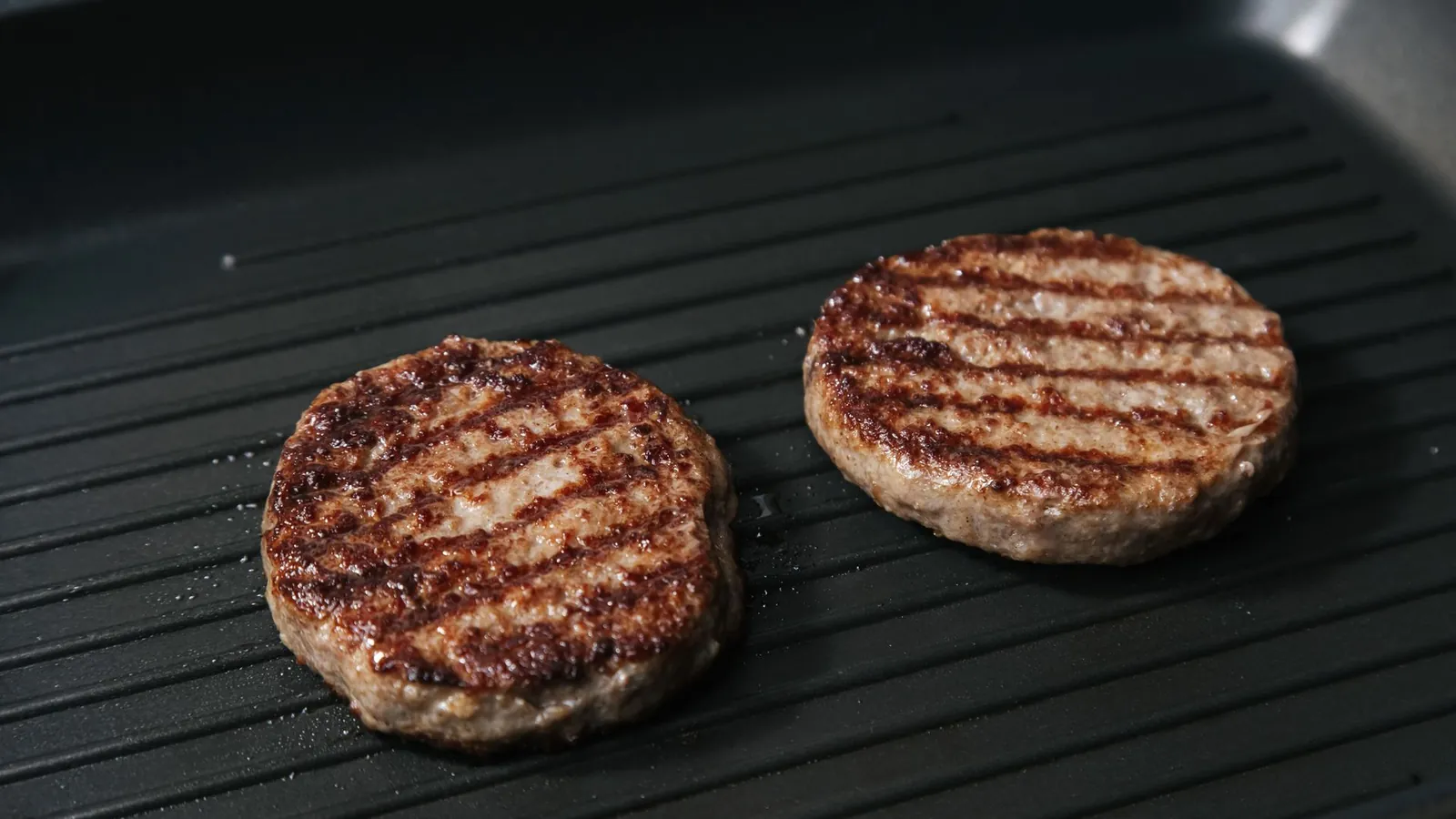
Imagine a production cook placing a finished patty inside its bun. The raw patty looked comfortably wide. The cooked version now sits in the middle with a generous bread border, as though it has quietly stepped away from the edges.
The first idea is to make the raw patty bigger. That may change the final fit, but it does not explain the behaviour. To understand where the edges went, look at protein contraction, water and fat release, and the way the patty changes shape during cooking.
Heat asks the structure to rearrange
Meat contains proteins, water and fat arranged within tissue. Heating changes the proteins and can cause the structure to contract. Some water is expelled, and some fat melts and may leave the patty. These changes influence size, cooked mass and juiciness.
They do not happen identically in every formulation. A leaner mixture and a fattier one start with different balances. The condition of the meat, its water-holding behaviour and the rest of the formulation also affect what remains inside after cooking.
Visible liquid on the cooking surface is a clue, but it does not tell you everything about its origin. It may contain water, fat and dissolved material. Avoid diagnosing a binding problem from the appearance of a puddle alone.
Smaller across does not mean lighter by the same amount
A patty can narrow while becoming thicker. That is a shape change. It can also lose mass as liquid and fat leave. That is cooking loss. The two can happen together, but measuring one does not replace measuring the other.
Record raw and cooked mass, width and thickness. Use the same resting or draining procedure before the cooked measurement. Otherwise, one sample may be weighed with surface liquid while another has already left that liquid on the tray.
For irregular shapes, a photograph beside a scale marker can help explain what a single width measurement misses. Keep the viewpoint consistent. The aim is to see how the patty changes, not to find the most flattering camera angle.
Look at the mixture before the mould
Check the meat composition and the consistency of trimming or fat distribution. A recipe may call for the same ingredient weights while the actual lean and fat balance varies. Link the trial to the ingredient lot rather than relying only on the recipe name.
Particle size affects how the pieces pack together and how the cooked structure feels. Mixing influences distribution and binding. More intensive mixing can also shift the bite towards a denser texture, which may be wrong for a patty meant to feel loosely structured.
Record the temperature and condition of the mixture during grinding, mixing and forming. Smearing or uneven distribution can make the raw mixture look different and behave differently. Keep the established cold handling controls throughout the comparison.
Forming leaves a memory in the shape
Portion mass, mould dimensions and forming pressure influence the starting geometry. Compare patties made consistently before deciding that an ingredient changed shrinkage. A thicker centre or tightly compressed edge can make an uneven starting point harder to interpret.
Handle the raw patties in the same way between forming and cooking. A chilled patty and a partly frozen one do not begin with the same thermal condition. Use the product state intended for the cooking process and record it clearly.
Observe the cooked outline as well as the diameter. Cupping, cracking and irregular edges may point towards uneven forming or cooking conditions. A tidy average width can hide a shape that still fits the bun badly.
The cooking comparison must be fair
Use the same validated cooking endpoint for every candidate. Making a patty appear juicier by cooking it less is not a valid improvement. Follow the plant's established food safety checks and measurement method.
Keep equipment loading, contact with the cooking surface, turning and holding consistent. Pressing a patty during cooking can expel liquid and alter shape. If pressing is part of the intended operation, standardise it; if it is an occasional habit, capture that difference.
- Confirm ingredient composition and the condition of the raw mixture.
- Match portion mass, particle size and forming geometry.
- Use the same starting product state and validated cooking endpoint.
- Measure cooked mass, width and thickness after a consistent rest.
- Assess juiciness, bite, cracking and fit in the intended bun.
A better fit still needs a good bite
Ingredients that help retain water or support binding may be useful, but their suitability depends on the product. Judge any change against texture, flavour and the intended ingredient declaration. Check the current FSSAI regulations, and ask our team for starting levels when planning an ingredient trial.
The winning patty is not simply the one that stays widest. It should cook safely, eat well and fit its role in the finished food. Ask Specsy or the SpecSol team to help read the measurements together. Then the bun can return to being a partner, rather than a ruler showing what disappeared.