

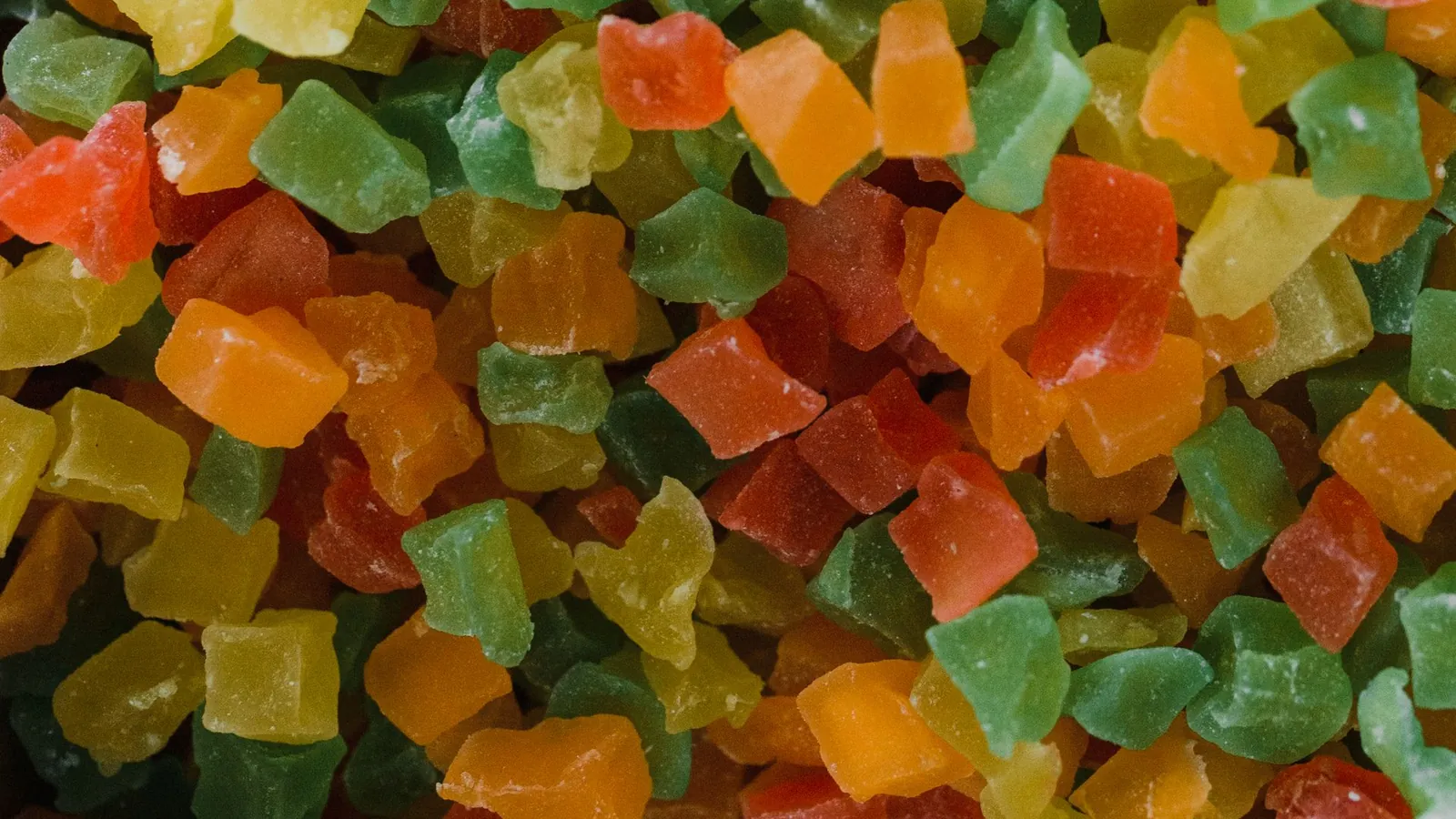
Imagine a packing operator lifting a jelly sweet from yesterday's trial. The shape is tidy and the colour cheerful. Unfortunately, the wrapper comes along for the ride. The sweet has acquired a sticky jacket, and every attempt to unwrap it makes the jacket more obvious.
The obvious response is to strengthen the gel. Yet a firm centre and a sticky surface can exist quite happily together. Before changing the gelling system, separate what is happening inside the sweet from what is happening where it meets the air, coating and wrapper.
The centre and the surface have different jobs
The gel network gives a jelly sweet its shape and much of its bite. The surface is the contact point with everything around it. A sweet can resist squeezing while a thin layer at its surface feels tacky or wet.
Cut a representative sweet and compare the centre with the outside. Does the whole piece slump, or is the shape stable? Is there free liquid, a dissolved coating or simply a tacky film? Those descriptions lead to different investigations.
Liquid can also be released from a gel that is not holding water well. If the surface looks wet, include that possibility instead of assuming the room air caused it. The aim is to identify the route taken by the moisture, not to attach the word sticky to every defect.
Moisture keeps moving after moulding
Water can move within the sweet and between the sweet and its surroundings. The direction depends on the relative moisture conditions, often described through water activity and the humidity of the air. Total moisture and water activity are related concepts, but they are not interchangeable measurements.
Sugars and other soluble ingredients affect how water is held. A coating can take up moisture, partially dissolve and become a sticky layer. That makes the coating part of the formulation problem, rather than a decoration that can be ignored during development.
Watch for temperature changes too. A cool surface exposed to warm, humid air can collect condensation. The sweet may then enter the wrapper with moisture it did not have when it left the conditioning area.
Conditioning deserves a proper place in the process
Conditioning is the controlled period in which the sweet reaches the state needed for the next operation. Depending on the product, that may include moisture redistribution or drying. It should have a defined endpoint, not merely last until the packing line becomes free.
Record room conditions, tray arrangement, loading and the condition of the sweets before packing. Pieces crowded together may experience different airflow and contact from pieces in an open arrangement. Compare locations as well as the most convenient tray near the door.
Do not solve tack by leaving sweets exposed indefinitely. Excessive drying can change the bite and create a surface that no longer matches the centre. Product protection and hygiene remain part of conditioning, even when the immediate complaint is a wrapper that refuses to let go.
A coating needs to suit the sweet
A sugar coating, an acid-containing coating and an oil-based finish behave differently. Their ingredients, application and distribution affect how the surface feels and how it responds to storage. Compare the actual coating specification and process, not just its name on the recipe.
Apply coatings consistently during trials. Patchy coverage can produce local sticking that looks like a random packaging fault. Check whether the tackiest pieces came from the same part of the coating run or the same position in a tray.
Assess flavour and bite as well as release. A change that prevents sticking but leaves an oily feel, harsh sourness or an unwanted shell has simply exchanged one problem for another. The surface should support the eating experience.
Follow the sweet into its wrapper
The wrapper controls contact and influences moisture exchange during storage. Its barrier properties, seal quality and fit all matter. A packaging description alone does not prove that the finished pack will behave as expected.
Use the intended wrapper in retention trials. Compare sweets before packing, after packing and through planned storage checks. Record where sticking occurs: across the whole face, at a compressed edge or around a damaged seal. Location can be more informative than a general sticky score.
- Check centre firmness separately from surface tack.
- Look for gel liquid release, coating dissolution or condensation.
- Record conditioning conditions and the state of the sweet at packing.
- Keep coating application and wrapper contact consistent.
- Compare retained packs under the intended storage conditions.
Let the wrapper leave politely
Choose the next trial from the evidence. A sound gel with a moisture-sensitive coating needs a different experiment from a weak gel releasing liquid. Keep a reference batch so that an improvement in release can be judged against changes in chew and flavour.
The best result is pleasantly uneventful: the wrapper opens, the sweet stays neat, and the bite feels right. Ask Specsy or the SpecSol team about the stage where the stickiness first appears. That small detail can make the next trial much easier to unwrap.