

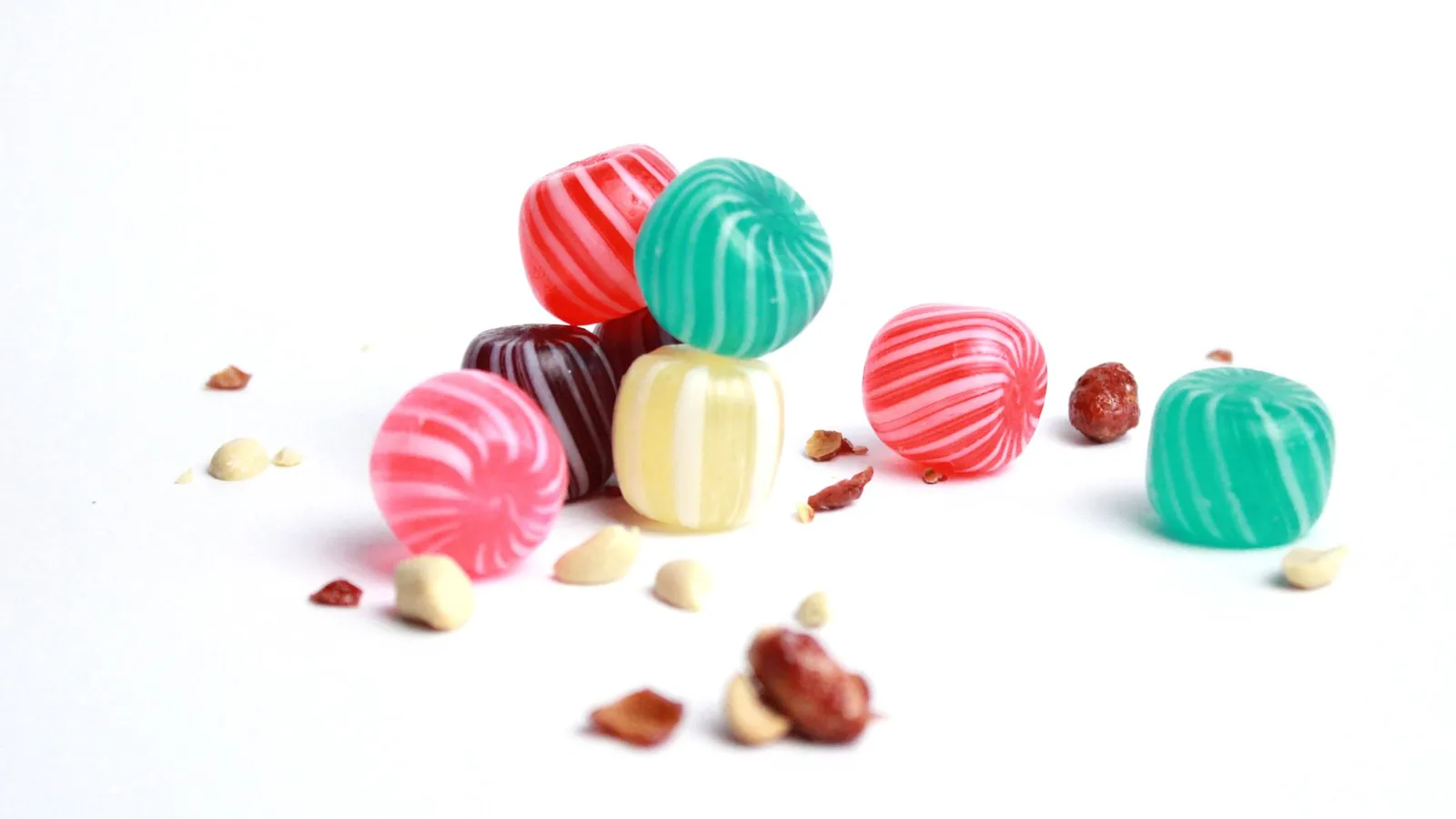
The operator turns the sweet towards the light, then tries another from the tray. Some pieces still look like little coloured windows. Others have cloudy patches and break with a rough, crumbly edge. In this imagined confectionery room, the sweets have started changing their character after they seemed finished.
The temptation is to blame cooling alone. But an unwanted crystal can have a longer story: how the sugar dissolved, what touched the mass, how much moisture remained and what happened after packing. Following that story is the route back to a clean snap.
A glass does not need to be a window
A hard sweet can hold its sugars in an amorphous, or glassy, state. In plain words, the molecules are arranged without the orderly repeating pattern found in a crystal. They are also moving slowly enough for the material to feel hard and brittle under the intended conditions.
That disordered structure can give the sweet its clear appearance and characteristic fracture. It is different from a deliberately crystalline sweet, where many fine sugar crystals are part of the intended texture. The same broad ingredient group can therefore make very different bites.
Neither structure is universally better. A fine crystalline structure can be welcome in fudge. In a clear hard sweet, unwanted crystals usually interfere with the appearance and snap the developer intended.
Crystals need a start and room to grow
Crystallisation involves molecules arranging themselves into an ordered structure. A small existing crystal can provide a starting point. Residual sugar on equipment, undissolved particles or crystals carried in from another operation may therefore matter even when the main mass looks smooth.
Once crystals grow, they scatter light and can change how the sweet breaks. A dull patch may become a useful early clue before the whole piece feels grainy. Appearance alone is not a complete diagnosis, but it tells the team where to look more closely.
Different sugars and syrup components influence how readily sucrose crystallises. Recipe balance helps control the tendency, but it cannot excuse inconsistent dissolution or contaminated equipment. A well-designed formulation still needs a process that preserves the intended structure.
Moisture makes the glass more mobile
Water softens a sugar glass by increasing molecular mobility. A sweet that picks up moisture from humid air can become sticky, and conditions that allow greater mobility can also encourage unwanted crystallisation.
This does not mean every sticky sweet is already grainy. Surface stickiness and crystal formation are different observations, and they can develop at different rates. Record both rather than using either word as shorthand for every storage defect.
Moisture left after cooking also matters. Two batches that look equally clear on the cooling table may respond differently later if their final moisture conditions differ. Follow the established process checks instead of judging the cooking endpoint by colour alone.
Trace the route from cooker to wrapper
Begin with dissolution and the condition of product-contact surfaces. Check places where dried residues can remain or where exposed sugar might enter the cooked mass. Review cleaning and start-up practices alongside the normal production record.
Then look at cooling and handling. The mass must move through the process without unnecessary opportunities for moisture pickup or the introduction of crystal seeds. Ambient conditions around an exposed cooling surface can be as relevant as the setting on the cooker.
Finally, examine the time before wrapping, the pack material and the seal. A moisture barrier only helps when the finished pack performs as intended. A gap at a seal can turn a promising material choice into a poor storage result.
A checklist for the cloudy batch
- Identify whether the change is surface stickiness, internal cloudiness or a grainy bite.
- Compare cooking records and the agreed final-moisture checks.
- Inspect equipment and handling points for residual sugar crystals.
- Record exposure between cooling, forming and wrapping.
- Check pack identity, seal quality and storage conditions.
- Retain matching samples to follow appearance and texture together.
Use samples from known positions and stages. If all cloudy pieces came from the start of a run, that is a different lead from cloudiness spread across every pack after humid storage. Keep the batch identity and handling history with the observations.
Make the comparison earn its answer
Choose a focused change and retain a reference. Improved cleaning, reduced exposed handling or a packaging adjustment can each be worth investigating, but changing everything together hides the cause of improvement.
Assess the sweets in their intended packs through relevant storage conditions. A clear piece straight after manufacture is a starting point, not proof that it will keep its texture. Follow clarity, stickiness and bite using consistent checks.
The imaginary operator can now bring more than a cloudy sweet to the next discussion. There is a trail of observations from the cooker to the wrapper. That trail makes the problem less mysterious, and gives the next batch a better chance of keeping its bright, satisfying snap.