

Imagine a flavour developer opening a bag of free-flowing powder. A bright aroma rises from something that looks nothing like oil. A colleague tips a little into a cup and watches it disperse. The obvious question is a good one: how did a liquid flavour become an ingredient that can be scooped?
One route uses an emulsion followed by drying. Gum arabic can help prepare and protect the flavour droplets along that route. The result makes a liquid flavour easier to handle in some applications, but the journey involves more than hiding oil inside a dry coat.
First, persuade oil to share the water
Flavour oils do not simply dissolve into water. Mixing can divide oil into small droplets, creating an emulsion, but those droplets need help to remain dispersed. Without suitable stabilisation, droplets can join together and the oil can separate.
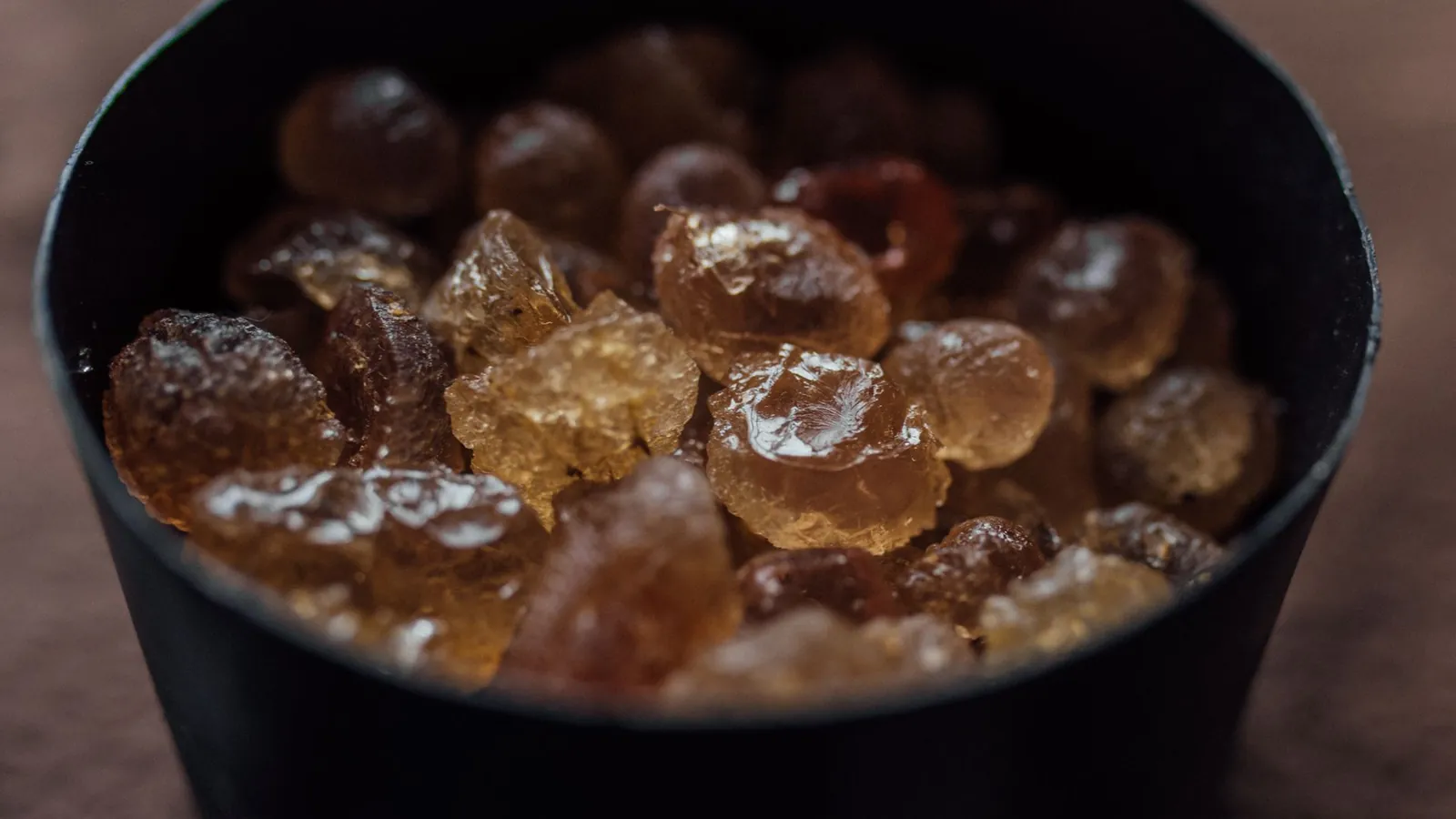
Gum arabic is a water-soluble gum obtained from acacia trees. Its composition includes material with a protein component that contributes to its behaviour at the boundary between oil and water. In practical terms, it can help form a protective layer around flavour droplets.
That interfacial role is important. Gum arabic is not being chosen to make the surrounding water thick; in fact, it stays relatively fluid even at high concentrations, which helps when a feed has to be pumped and sprayed. Its ability to help stabilise droplets and contribute to a dried matrix makes it useful in certain flavour systems. The grade and formulation still need to suit the particular oil and process.
Drying changes the surroundings
In spray drying, the prepared liquid feed is broken into droplets and brought into contact with heated air. Water evaporates, leaving dry particles containing the carrier material and the flavour. The process needs to balance drying with retention of the desired volatile compounds.
Inside the resulting powder, oil can be distributed within a solid matrix. The familiar image of a neat capsule with a single liquid centre is useful only up to a point. Actual particles can have more complicated structures, and some oil may remain closer to the surface.
Surface-exposed oil is less protected than oil held within the particle. Feed emulsion quality, carrier choice and drying conditions all influence the outcome. A powder that pours nicely has passed a handling test, but that appearance alone cannot tell how well its aroma has been retained.
Protection has a purpose and a limit
Encapsulation can make a flavour oil more convenient to distribute in dry mixes and can help protect it from its surroundings. It may reduce exposure to oxygen or slow losses compared with an unprotected form, depending on the system. It does not make aroma compounds indestructible.
Some volatile compounds can be lost during preparation or drying, and further changes can occur during storage. Different compounds may be retained differently, changing the balance of the flavour. Evaluate character as well as overall strength rather than assuming the original oil is reproduced perfectly.
Moisture uptake can alter powder behaviour and the condition of the surrounding matrix. Oxygen exposure and storage temperature also deserve attention. Suitable packaging and dry handling remain part of the protection strategy; the word encapsulated does not remove those responsibilities.
The flavour must come out at the right moment
A protective powder is useful only if it performs when added to the intended food. In a drink mix, the powder must wet and disperse appropriately, and the flavour should emerge with the intended character. In a dry seasoning, moisture and saliva during eating provide a different environment.
Check the finished application rather than judging only the aroma released when the bag opens. A strong smell from the dry powder is not a direct measurement of how much useful flavour will reach the food. It may reflect compounds that are readily available at the particle surface.
Observe dispersion, any surface oil, sediment and the timing of aroma release. Heating, acidity and the food's other ingredients can change performance. A flavour powder that behaves well in plain water may need a separate assessment in a protein-containing drink or a cooked filling.
- Define whether the priority is dry handling, protection or flavour delivery.
- Check the supplied carrier composition and preparation guidance.
- Compare powder dispersion in the complete food.
- Assess flavour character as well as perceived strength.
- Repeat the comparison after storage in the intended packaging.
Make a fair powder-to-powder comparison
Equal masses of different flavour powders need not deliver equal quantities of flavour oil. Carrier composition and flavour loading may differ. Read the specification and choose a meaningful comparison basis before deciding that one powder is weaker or less effective.
Keep preparation, serving temperature and tasting time consistent. If a trial changes the carrier system, note any effects on texture or appearance too. The best result combines the desired flavour with workable handling and reliable behaviour in the product.
Our imagined scoop has now travelled from oil droplets to dry particles and back into food. Ask Specsy or the SpecSol team to help follow that route for your application. The protective coat should make the flavour easier to use, then let it arrive where it belongs.