

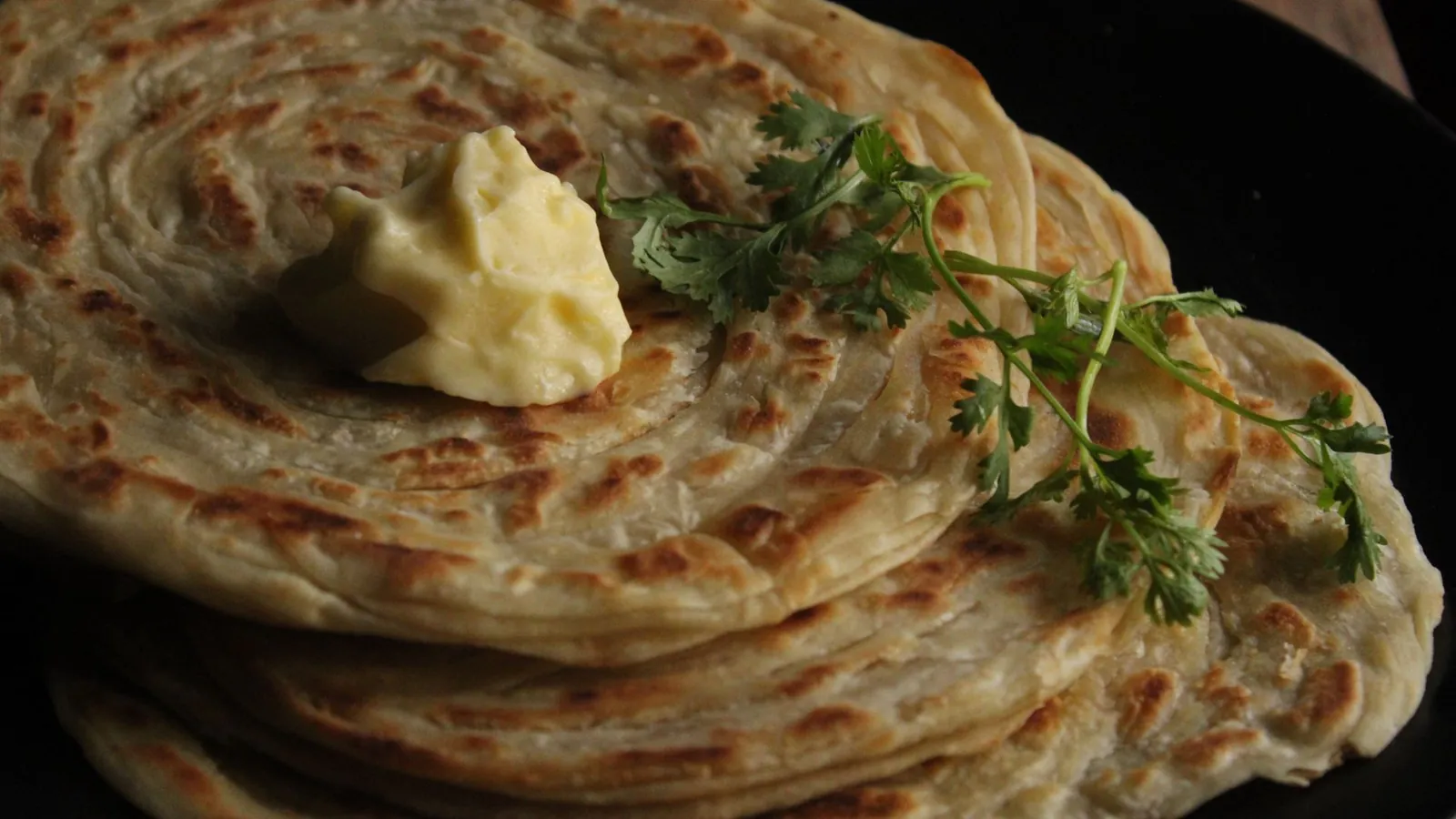
Picture a development cook tearing into a freshly cooked paratha. The surface looks golden and the aroma is inviting. The expected flakes, however, are missing. Instead of lifting apart, the centre stretches into a solid sheet. All that careful layering seems to have vanished on the way to the pan.
A layered paratha is built before it is cooked. Dough and fat must form a useful arrangement, and that arrangement has to survive later handling. The final pan reveals the structure that reached it, including damage that may have happened much earlier.
Separate layers need somewhere to begin
Lamination creates thin regions of dough separated by fat. The fat helps prevent neighbouring dough surfaces from joining into a continuous mass. During cooking, heat and water vapour help the layers open, while the dough sets into its final texture.
Folding creates the arrangement, and sheeting stretches it. Both operations matter. A neatly folded piece can still lose useful separation if later rolling breaks the fat distribution or presses exposed dough surfaces firmly together.
The goal is not simply a visible swirl on the raw piece. Layers must remain distinct enough to open under the intended cooking method. Inspect the structure at several stages instead of deciding that a tidy coil guarantees a flaky result.
Fat needs the right working consistency
Fat that is too firm for the dough can resist spreading and break into patches. The dough may stretch around those patches, leaving gaps in the intended separation. Fat that is too soft can smear or squeeze out, again leaving dough surfaces in contact.
The useful working condition depends on the fat and the process. Temperature affects consistency, but a single temperature reading does not describe every fat's behaviour. Earlier storage and conditioning can also influence how it spreads during lamination.
Judge the dough and fat together. A soft dough paired with a much firmer fat behaves differently from materials that deform comfortably alongside each other. Record actual material condition at the bench or sheeter rather than relying only on room temperature.
The sheeter can preserve or erase the work
Watch how the dough moves through each reduction. Excessive stretching, abrupt reduction or poor alignment can create tears and uneven thickness. Once dough breaks through a separating layer, contact between neighbouring dough regions becomes more likely.
Dough development and resting influence how readily it stretches. Dough that keeps pulling back may invite repeated rolling or extra pressure, which adds more handling. Investigate why it resists before treating force as the only available answer.
Follow the established method for dusting and surface handling. Extra flour is not a universal repair for disrupted layers and may change the eating texture. Keep records of handling differences so a trial is not quietly rescued by techniques that normal production cannot repeat.
Freezing cannot rebuild missing layers
Inspect pieces before freezing. If the separation has already been lost, the freezer will preserve that problem rather than reverse it. Compare shape, thickness and visible structure as the pieces leave forming and enter the freezing stage.
Then examine stacking and contact between pieces. Pressure, sticking or deformation while the dough is still soft can change the geometry. Use the intended separators, supports and handling procedure consistently, and check whether the first and last pieces experience different waits.
Temperature history during frozen storage and distribution also matters. Unintended warming can soften the dough and fat and make handling damage more likely. Review the cold-chain record and pack condition when a product performs differently after storage.
Let the intended cooking method judge
Cook comparison samples using the method intended for the product. Keep the starting frozen condition, cooking surface, handling and endpoint consistent. A carefully adapted laboratory method may hide a weakness that appears when the printed instructions are followed.
Look beyond the surface colour. Open the cooked paratha and assess the centre, the ease of layer separation and the balance between tenderness and crispness. Record greasy patches, dense bands and uneven cooking separately, because they point towards different parts of the process.
- Compare dough and fat working consistency before lamination.
- Inspect fat distribution and dough tears after sheeting.
- Record resting, folding and handling conditions.
- Check shape and layer structure before freezing.
- Follow stacking, freezing and storage history.
- Judge layer opening under the intended cooking method.
Keep a reference and change a defined part of the process for the next trial. If layers are visible before freezing but disappear after a particular handling stage, concentrate there. If the dough already looks fused after sheeting, the cold store is unlikely to be the starting point.
This investigation is different from ordinary chapati hardening during storage. Here, the question is whether a deliberately layered structure was built and preserved. Keeping that question clear saves the team from chasing every possible cause of a firm bite.
The next paratha should have something to show when it is torn open. Ask Specsy or the SpecSol team to review your lamination and cooking observations. A little attention to where the layers meet can help them part more gracefully at the table.