

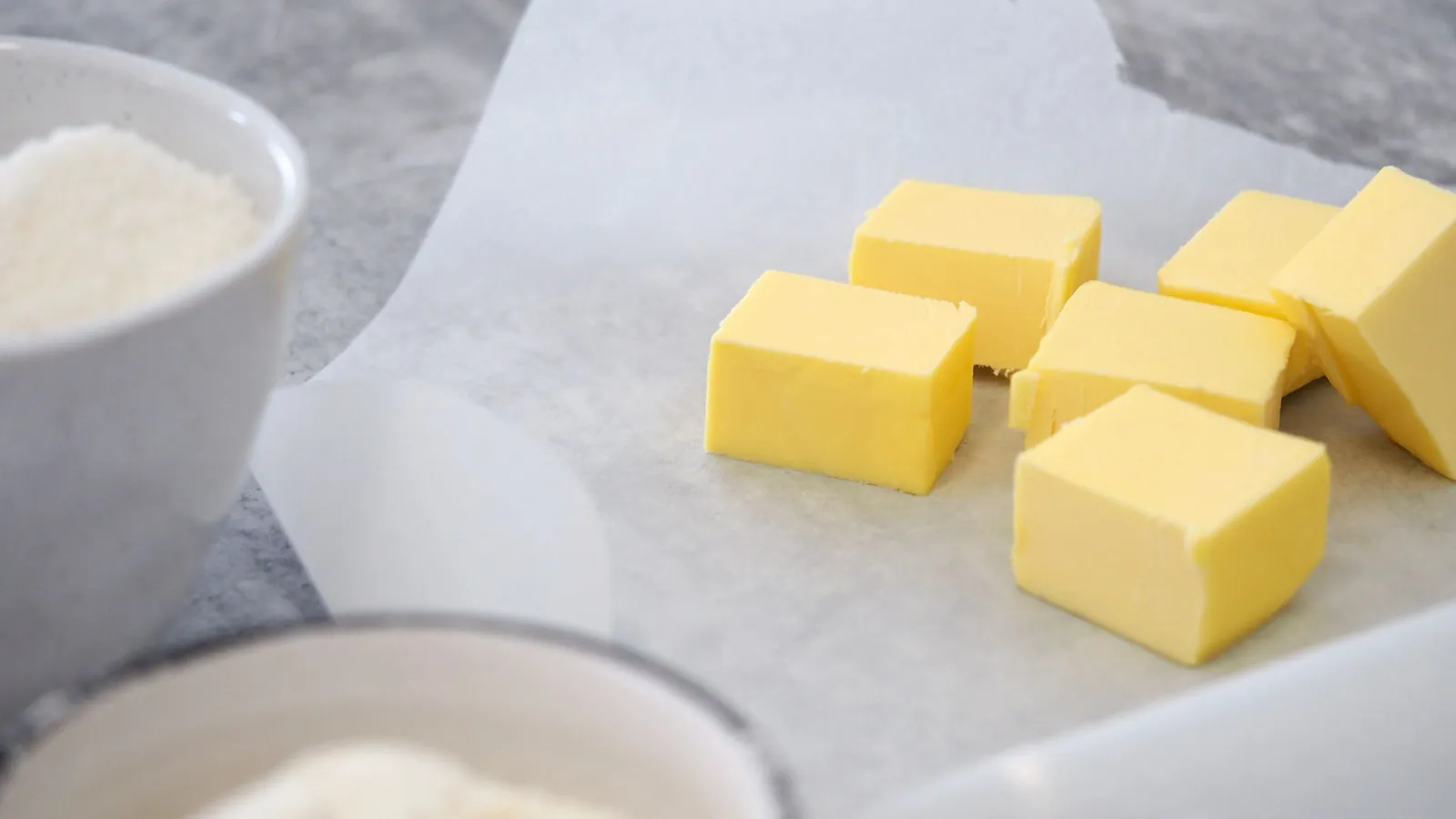
Picture a dairy operator laying a firm block of butter on the packing bench. The first portion cuts neatly. A little later, the knife smears, the wrapper shines and the next portion slumps at the corners. Nothing has been added to the recipe. Yet the butter seems to have changed its mind about being solid.
Before blaming the fat source or asking for a firmer formulation, follow the block's journey. Butter texture depends on what its fat is doing at that moment, and on what happened to it earlier. The packing bench can reveal a story that started well before packing.
A block with a hidden framework
Butter contains fat in both solid and liquid forms, with small water droplets dispersed through the continuous fat phase. The solid portion is organised into crystals. Together, those crystals form a network that helps hold liquid fat in place and gives the butter its shape.
Think of a framework supporting a softer filling. The amount of solid fat matters, but so do the arrangement of the crystals and the connections between them. A butter block is therefore more interesting than a lump of chilled oil. Its internal structure helps determine whether it cuts, bends, spreads or smears.
Milk fat contains a mixture of components that melt over a range of temperatures. As butter warms, some crystals melt while others remain. There is no single instant when every part switches from solid to liquid. That gradual change explains why a block can become soft and greasy before it looks fully melted.
The thermometer needs a travel diary
Warm surroundings, contact with equipment and time spent waiting can all change the condition of butter during handling. The outside may warm sooner than the centre. A firm centre does not prove that the surface is ready to pass cleanly through a cutter or wrapper.
Cooling history also matters. As fat cools, crystals form and develop. Different cooling and holding histories can leave different structures, even when samples eventually reach the same measured temperature. Returning a softened block to the chiller does not necessarily recreate its earlier texture immediately.
That is why a final temperature reading needs context. Record where the butter was held, how it was transferred and where it waited. Include pauses on the line. A short production interruption can become a long wait for the last block in a queue, especially in a warm packing area.
Working changes the framework too
Butter is worked during manufacture to develop its structure and distribute moisture. Mechanical handling can also break connections within the fat crystal network. The response depends on the butter's temperature, composition and previous treatment. More working is not automatically a route to a smoother, more stable product.
Watch the butter as it passes through each handling step. If it cuts cleanly before a transfer but smears afterwards, that transition deserves attention. If the surface becomes oily while blocks simply wait, warming is a strong lead. These observations guide the investigation without proving that only one mechanism is involved.
A surface sheen is also different from visible water droplets. Record what is actually being released rather than labelling every shiny patch as oil. Appearance, touch under an agreed method and appropriate moisture checks can help the technical team decide which part of the structure needs investigation.
Compare like with like
A cold reference block and a warmer trial block cannot fairly settle a formulation argument. Condition samples to the same agreed temperature and allow enough time for that condition to become consistent through the sample. Keep their earlier handling histories recorded rather than assuming equal temperature erases them.
Then compare cutting, spreading, surface oiliness and shape retention separately. A butter that spreads pleasantly may not behave identically on a packing line. Equally, a very firm block is not automatically the better eating product. Decide which behaviour needs improvement before ranking the samples.
- Record the butter condition at storage exit, line entry and packing.
- Note waiting periods, equipment contact and repeated handling.
- Compare samples with matched size, temperature and conditioning time.
- Describe surface oil, water droplets, smearing and firmness separately.
- Retain packed samples to see whether the chosen change holds up.
Make the next block easier to understand
Start with a manageable comparison, such as a controlled difference in waiting time while other conditions stay consistent. Keep it within the established handling procedure. Observe the beginning and end of the packing run, because the last portions may have experienced a different journey from the first.
Back at our imagined bench, the useful question is no longer simply whether the butter is too soft. It is where the structure lost the support the line needed. Bring that question to Specsy or the SpecSol team, and the oily wrapper becomes a useful clue rather than an irritating mystery.