

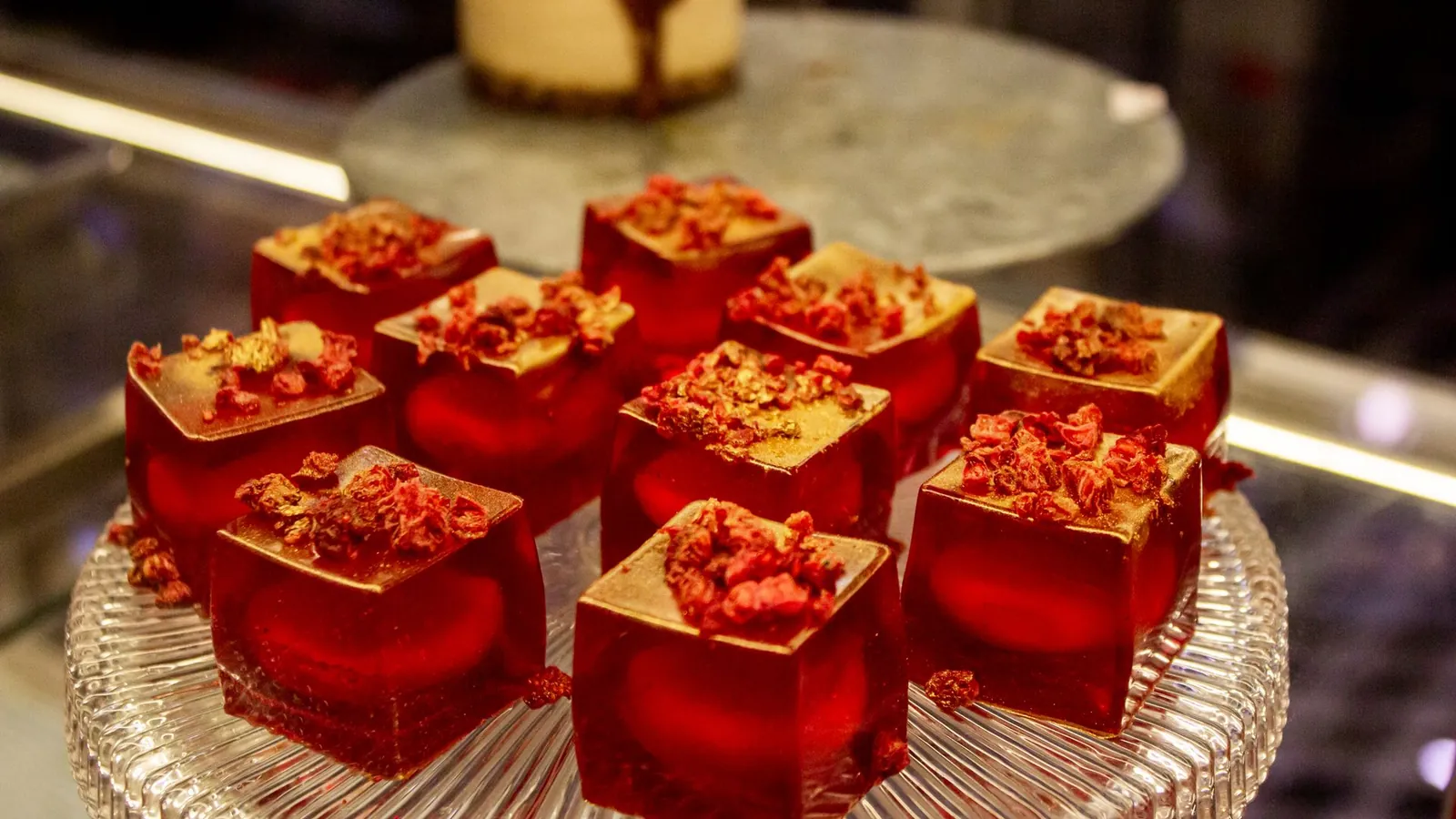
Picture a dessert developer cutting a tray of jelly into neat cubes. The knife leaves beautifully sharp faces, and every piece stands proudly on the plate. Then comes the tasting. Instead of a springy bounce, the cube breaks with a clean, surprising snap.
The agar may be doing exactly what agar does well. A gel can be firm enough to cut cleanly yet relatively brittle when bitten. The useful question is whether that behaviour suits the dessert, rather than whether every jelly ingredient can be persuaded to feel the same.
Firmness and bounce are different jobs
Agar is a gelling ingredient obtained from certain red seaweeds. In a suitable preparation it forms a network that holds water and gives the product shape. Its gels are commonly characterised by a firm, comparatively brittle texture, although the exact result depends on the formulation and processing.
Firmness describes resistance to deformation. Elasticity describes how well something recovers after deformation. Fracture describes how it breaks. These properties can move differently, so a cube that resists the spoon may still break abruptly once enough force is applied.
This distinction helps a development team discuss the target. Cleanly cut pieces in a dessert may benefit from a short bite. A confection expected to stretch or bounce asks for something else. Start with those expectations before choosing the gelling system.
Dispersion and dissolution are separate stages
Agar needs to be distributed through the liquid and then properly dissolved using a suitable heating procedure. Simply wetting the powder does not prove that it has dissolved. Poor dispersion can leave lumps, while incomplete dissolution can make the final result uneven or weaker than expected.
Follow the preparation guidance appropriate to the ingredient and product. Consider the equipment, mixing and the rest of the formula, because a crowded mixture may behave differently from plain water. Check the liquid itself rather than relying only on the vessel's heating setting.
Record when other ingredients enter the process. Sugar, acids and other components can influence preparation and the finished gel. Prolonged heating under strongly acidic conditions can damage agar's gelling performance, so addition sequence and heat exposure deserve particular attention in acidic products.
Cooling builds the network
After suitable dissolution, cooling allows agar chains to associate into a structure that gives the liquid its gel character. The mixture changes from something that can flow into a mould to something that can hold the mould's shape. That transition has practical consequences for filling and handling.
A line that waits too long before depositing may begin handling a setting mixture instead of a freely flowing one. Disturbing a developing gel can affect its final appearance and uniformity. Match the preparation and filling sequence to the actual equipment rather than only to a beaker trial.
Judge the gel after a consistent cooling and holding history. A newly set sample and one that has completed the intended hold are not automatically fair comparisons. Keep sample dimensions consistent too, since a thick cube and a thin sheet invite very different bites.
The setting point is not the melting point
Agar gels typically require a higher temperature to melt than the temperature at which they formed during cooling. This separation between setting and melting behaviour is called thermal hysteresis. The plain version is that the route down and the route back up do not use the same turning point.
That helps explain why a gel can form during cooling and then retain its shape under warmer serving conditions. It does not make every agar dessert suitable for every storage environment. The complete formulation, handling requirements and food safety controls still determine how the product should be kept.
It also means an agar gel should not be expected to melt in the mouth like every other familiar gel. Its fracture and breakdown during eating are part of its identity. Assess that bite directly instead of using appearance as a promise of a particular mouthfeel.
Give the cube a useful audition
- Define whether the target is firm, tender, elastic or clean-breaking.
- Record dispersion, dissolution and ingredient addition order.
- Check the route from hot preparation to filling and cooling.
- Compare gels with matched dimensions and holding histories.
- Assess cutting, fracture, mouthfeel and any liquid release.
- Repeat the assessment at the intended serving conditions.
Use simple descriptions before reaching for complex measurements. Does the spoon enter smoothly? Does the cube bend before breaking? Does it leave distinct fragments in the mouth? These observations give instrumental texture results a practical meaning and help the team agree what improvement looks like.
If the target needs a more elastic or softer bite, consider whether a different gelling system or a carefully developed combination is appropriate. Changing ingredients changes the preparation requirements as well as the texture. Trial the complete system, including flavour release and the way it is served.
The imagined cube has not failed by refusing to bounce. It has introduced itself. Ask Specsy or the SpecSol team to help match that personality to your dessert, and choose a gel that makes the first bite as pleasing as the clean cut.